

-

-
 2026-03-20MEGA Q High-Strength Steel Formwork Manufacturing: How Sampmax Solved Key Production ChallengesREAD IT >
 -
In modern construction, the performance of high-strength steel formwork panels depends not only on design, but also on manufacturing precision and process control.
During the production of MEGA Q steel formwork panels for an OEM project, Sampmax encountered several fabrication challenges related to structural configuration and welding execution.
Through controlled welding processes, specialized tooling, and targeted surface treatment, Sampmax ensured that the final panels achieved the required structural strength, dimensional accuracy, and concrete surface quality.
This project highlights Sampmax’s capability in high-strength steel formwork manufacturing and engineering-driven OEM production.
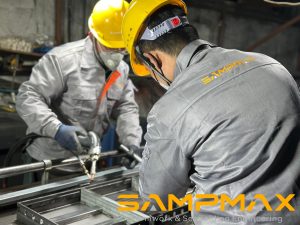
Structural Challenge: Panel Design Without Vertical Reinforcement Ribs
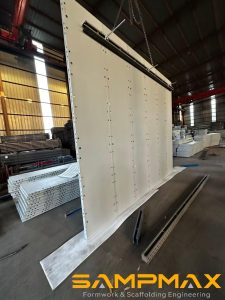
The MEGA Q panel design included large-format panels up to 3000 × 600 mm, incorporating multiple horizontal supporting tubes but no vertical reinforcement ribs.
From a manufacturing perspective, this created two major challenges:
•Panel Deformation During Welding
Without vertical reinforcement ribs to stabilize the panel surface, welding heat could lead to thermal deformation, resulting in surface unevenness and affecting both system alignment and concrete finish quality.
•Stress Concentration on Welded Joints
The absence of vertical reinforcement ribs caused structural loads to concentrate on the weld connections between the panel plate, frame, and supporting tubes, increasing the risk of local weakness under load.
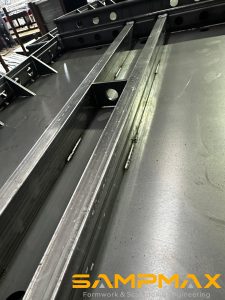
Sampmax Manufacturing Solution
To address these issues, Sampmax implemented precise and controlled manufacturing measures:
•Custom Welding Fixtures
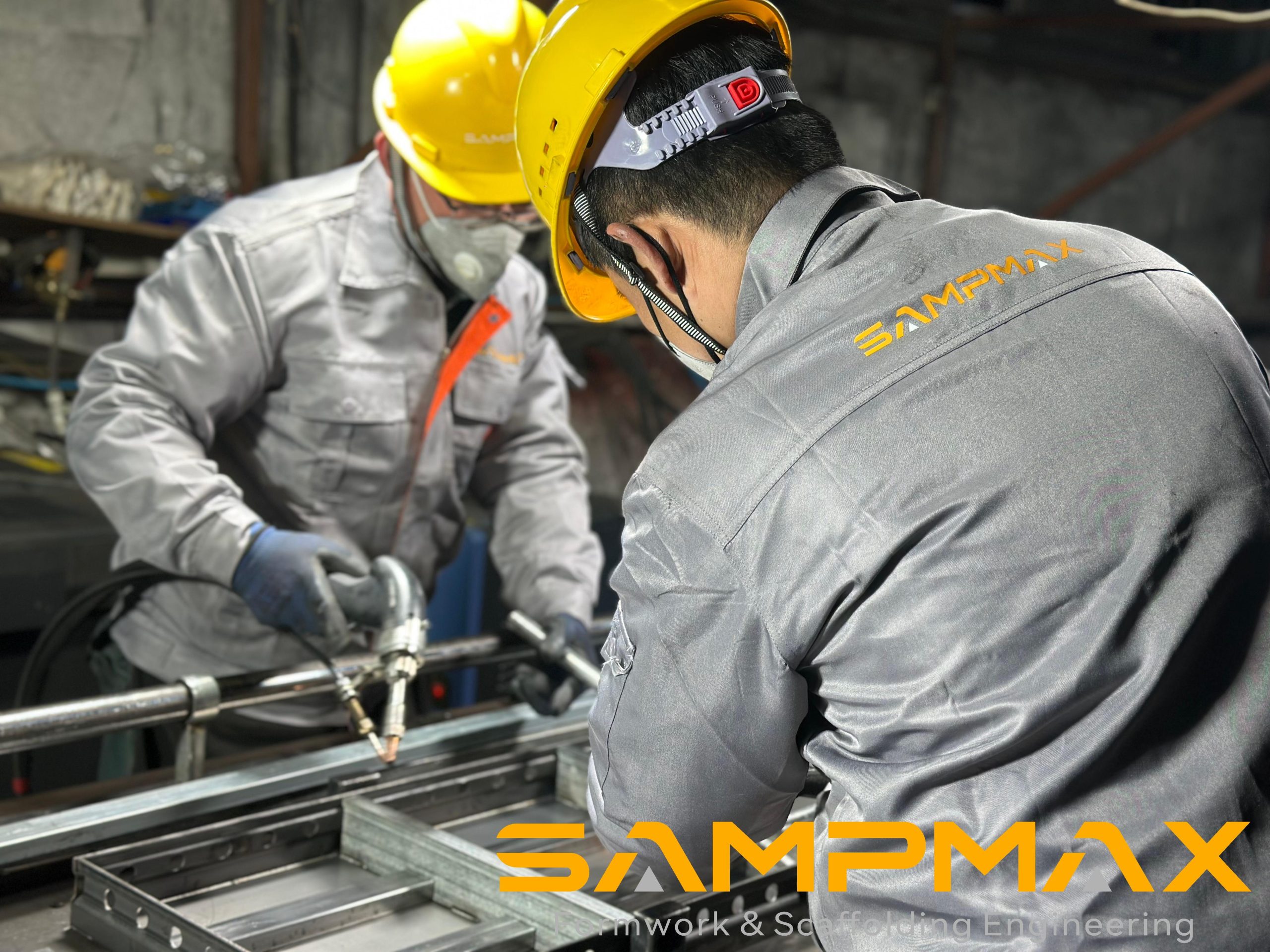
Dedicated fixtures were used during welding to firmly secure the panels, effectively minimizing heat-induced deformation and maintaining dimensional consistency.
•Hydraulic Press Flattening
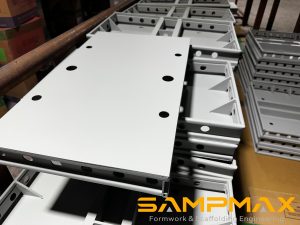
After welding, panels underwent hydraulic leveling to restore flatness and eliminate distortion caused by thermal stress.
•Optimized Welding Strategy
Different welding methods were applied based on structural requirements:
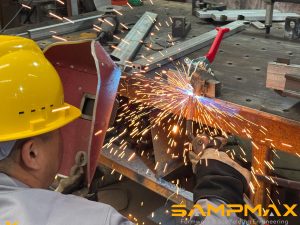
a. Laser welding was used between the panel plate and supporting tubes to control heat input and reduce deformation
b. CO₂ gas shielded welding was applied specifically at the connection points between supporting tubes and the frame to reinforce critical joints
This combination ensured both surface quality and structural reliability.
Engineering Capability in High-Strength Steel Formwork Manufacturing
In addition to process control, material selection plays a critical role in performance.
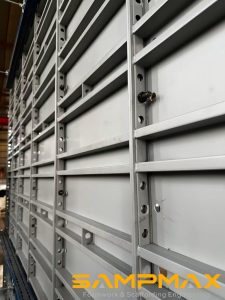
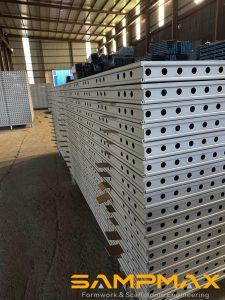
The MEGA Q system utilizes high-strength steel (Q980) to achieve superior load-bearing capacity and durability.
Sampmax also offers flexible material options based on project requirements, including:
a. Q700 high-strength steel
b. Zinc-Aluminum-Magnesium coated high-strength steel
Through engineering optimization and material customization, Sampmax delivers high-performance steel formwork systems tailored to global project needs.
Proven OEM & ODM Capability
This project demonstrates Sampmax’s expertise in:
a. High-strength steel formwork manufacturing
b. OEM / ODM formwork production
c. Welding process optimization
d. Quality control for concrete formwork systems
Similar to industry leaders such as Doka and PERI, Sampmax emphasizes engineering-driven manufacturing to ensure reliable performance under real construction conditions.
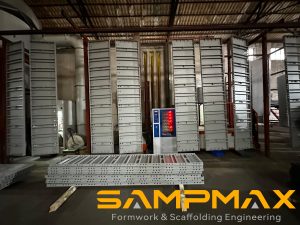
Whether for standard systems or customized OEM solutions, Sampmax maintains strict production standards to deliver dependable products worldwide.
FAQ – Steel Formwork Manufacturing
◎ What are the common challenges in steel formwork manufacturing?
Welding deformation, flatness control, structural design limitations, and consistent concrete finish quality.
◎ Why are reinforcement ribs important?
They improve panel stiffness and reduce deformation during both welding and concrete casting.
◎ How does welding affect panel flatness?
Heat input during welding can cause deformation, which must be controlled through fixtures and post-processing.
◎ What ensures a high-quality concrete finish?
Flat panel surfaces, proper grinding, and uniform coating are key factors.