


Vietnam’s construction industry continues to expand, with residential, commercial, industrial and infrastructure projects driving demand for efficient construction systems. In 2025, Vietnam’s construction sector recorded 9.62% growth, reflecting continued activity across the country’s built environment.
Aluminum formwork has become a familiar solution for repetitive concrete construction due to its lightweight structure and systematic installation. However, as contractors face growing pressure to control project costs, a key question arises: If both systems deliver required concrete forming performance, which provides better overall value?
For contractors in Vietnam, this comparison goes far beyond material weight. Initial investment, durability, reuse, structural capacity and long-term utilization all deserve careful evaluation.
1. Steel Formwork vs. Aluminum Formwork: At a Glance
| Factor | Steel Formwork | Aluminum Formwork |
|---|---|---|
| Initial Investment | More controlled investment potential | Generally higher project-specific investment |
| Weight | Heavier | Lighter |
| Structural Strength | High | High |
| Reuse Potential | High | High |
| Durability | High | High |
| Configuration | Modular | Modular |
| Long-Term Utilization | Suitable for repeated use across projects | Closely related to specific building layouts |
The core difference is not simply steel versus aluminum—it is about how the formwork system performs over its entire service life.

2. The Cost of Aluminum Formwork Goes Beyond Its Weight
One of the main reasons contractors consider aluminum formwork is its lightweight construction. However, weight is only one part of the economic equation.
Aluminum formwork is frequently designed around the specific dimensions and layout of a single project, requiring a significant upfront capital investment. The more project-specific a system is, the more critical it becomes to maximize its reuse cycles on that exact structure.
Contractors must evaluate more than purchase price—they need to consider how adaptably and effectively that initial investment can be utilized across future projects. This is where modular steel formwork provides a strong alternative.
3. Why Consider Steel Formwork?
Steel has long been proven in concrete construction for its strength, rigidity, and resistance to harsh site handling. A modular steel formwork system can be assembled, dismantled, and redeployed across multiple construction cycles while maintaining precise dimensional stability.
Key Advantages of Modular Steel Formwork:
•
•
•
•
•
•

4. Investment, Structural Performance & Weight Efficiency
The total economic performance of a formwork system should be evaluated using a comprehensive lifecycle model:
Structural Capacity: Formwork must safely withstand fresh concrete pressures during rapid pours. Steel provides an exceptional structural base; for instance, systems engineered to ≥60 kN/m² load-bearing capacity deliver benchmark stability for demanding high-rise and wall applications.
Rethinking Efficiency: While aluminum’s main appeal is lower weight, a lighter panel does not automatically translate to lower overall project cost. When factoring in component durability, long-term maintenance, and multi-project reuse, a robust steel system often delivers superior overall project economics.
5. MEGA S: A Steel Alternative for Vietnam
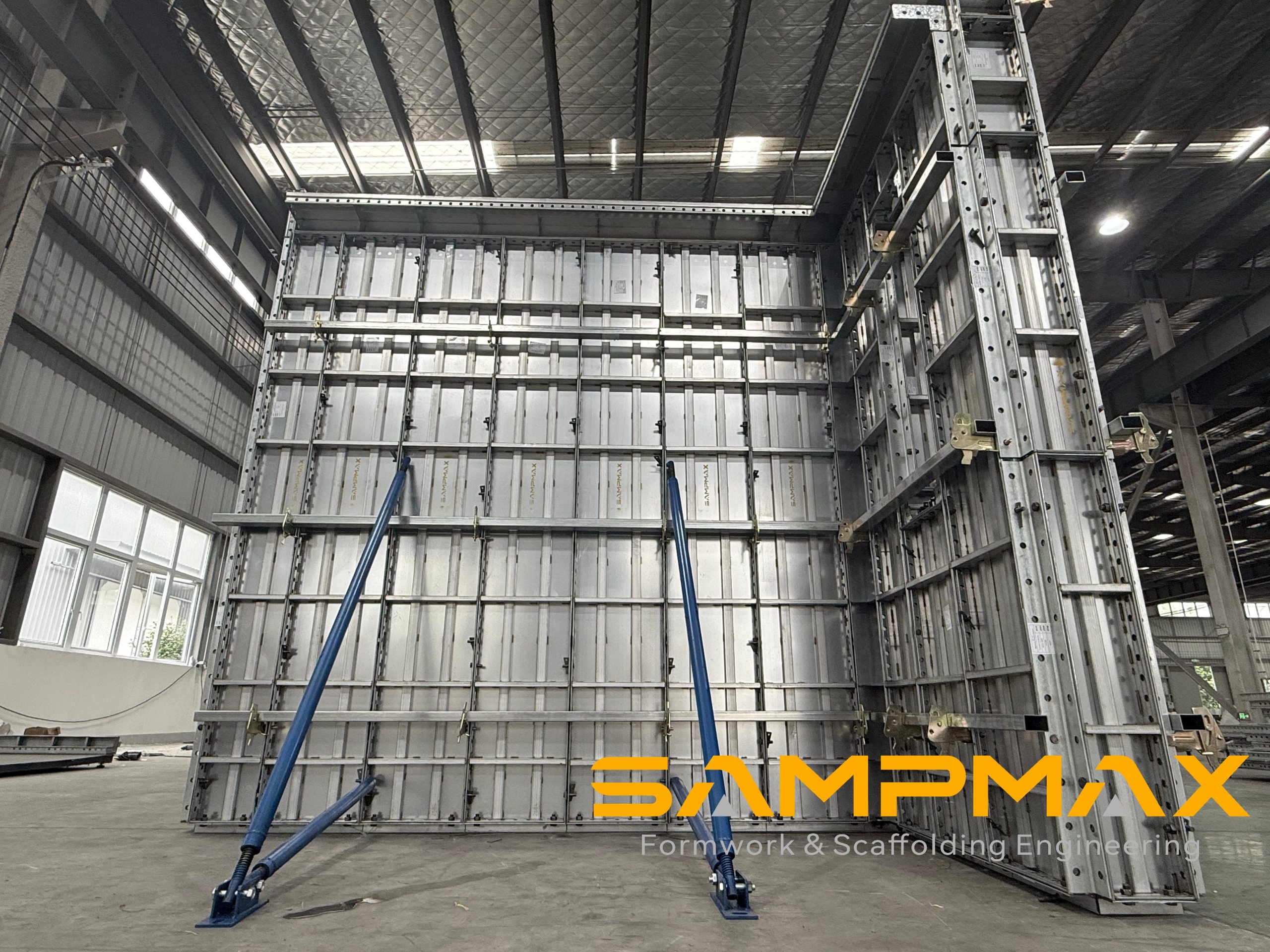
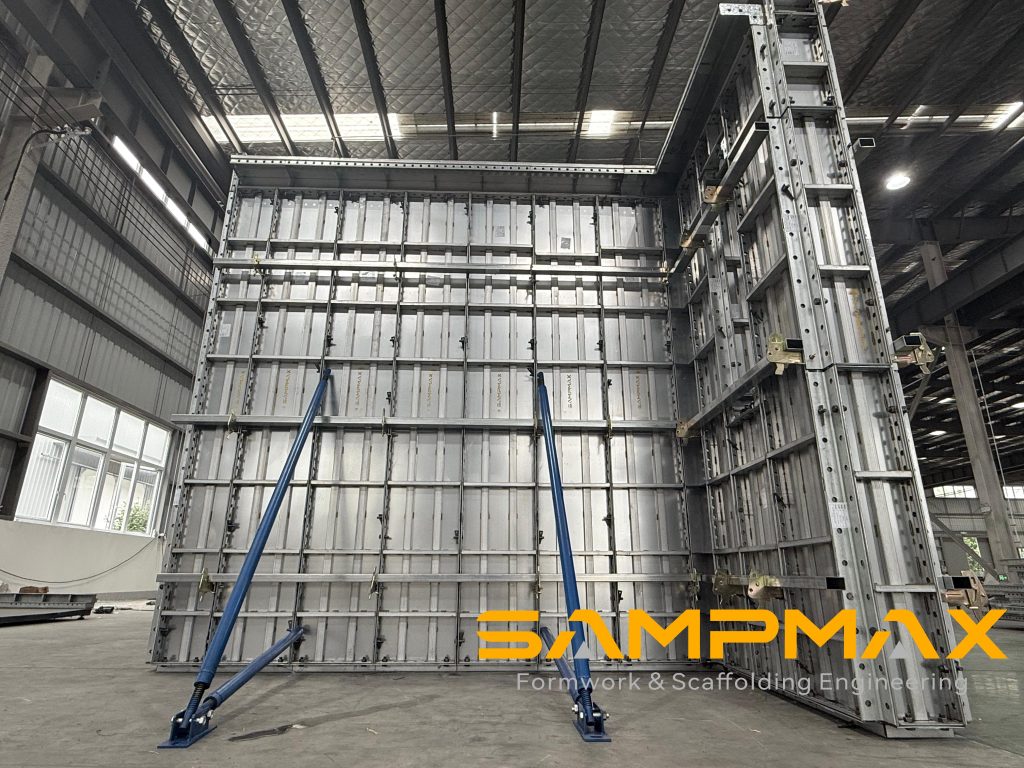
Sampmax MEGA S is a modular steel formwork system engineered for concrete wall and structural applications. It offers contractors a durable, highly reusable alternative while maintaining practical site handling and modular compatibility.
•
•
•
•
•
Looking Beyond Initial Cost in Vietnam
As Vietnam’s construction market continues its strong expansion, contractors are increasingly looking beyond single-project purchase price and installation speed when selecting formwork equipment.
A formwork system represents a significant asset investment. Its true value lies in how effectively it can be maintained, adapted, and redeployed across multiple construction cycles.
With ≥60 kN/m² load-bearing capacity, up to 200 reuse cycles, ~22 kg/m² weight, and a 65 mm frame profile, Sampmax MEGA S provides a practical, high-value alternative for modular concrete construction in Vietnam.
Looking for a steel formwork solution in Vietnam? Contact Sampmax today to discuss your project requirements and explore how MEGA S can optimize your project economics.