

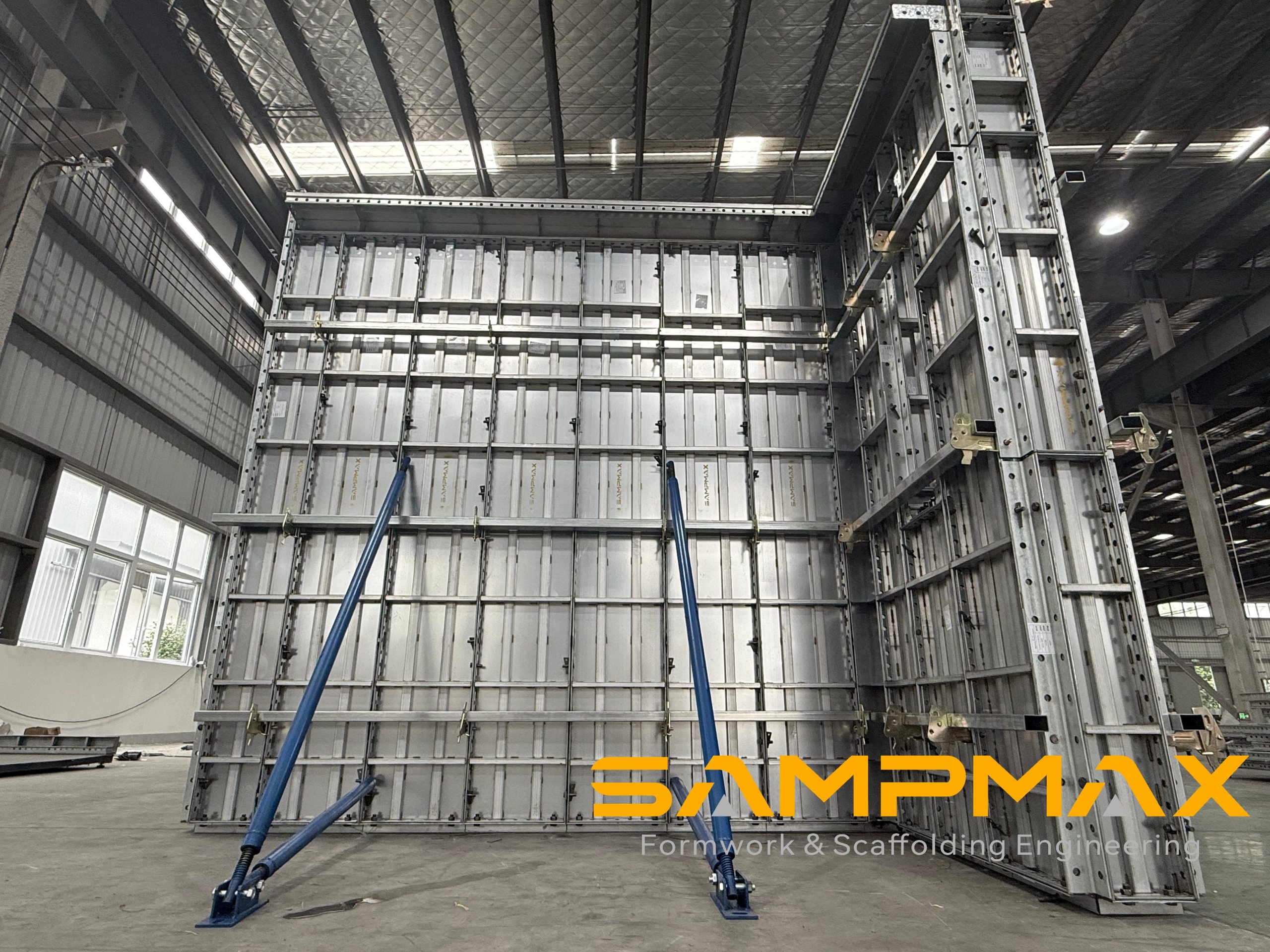

An honest comparison of aluminum slab formwork systems — PERI SKYDECK, DOKA DokaXdek, and Hünnebeck TOPEC — covering design, materials, site performance, and which system fits your project best.
Why This Decision Matters More Than Think
Your slab formwork choice directly determines cycle time, crane dependency, labor cost, and cost-per-floor across your entire project. Get it wrong, and you feel it three floors in.
This guide compares three mainstream aluminum slab formwork systems — PERI SKYDECK, DOKA DokaXdek, and Hünnebeck TOPEC — on the criteria that actually matter on site. No marketing language, just an honest look at what each system does well and where it falls short.
What to Evaluate Before You Commit
- Cycle time target — How many days per floor are you working toward?
- Panel weight — Lighter panels mean less crane time and less crew fatigue
- Component count — Fewer parts means faster setup and fewer site errors
- Reuse cycles — The key driver of long-term cost-per-floor
- Layout flexibility — Standard rectangular plates or complex infill zones?
- Market support — Availability of rental stock, spare parts, and technical help in your region
1. PERI SKYDECK: The Proven Aluminum Panel System
SKYDECK is PERI’s flagship aluminum slab system, widely used across residential, commercial, and industrial projects globally.
How it works
SKYDECK uses aluminum panels and main beams — each weighing up to 15.5 kg — that assemble according to a fixed grid sequence. The panel layout determines prop positions automatically, which eliminates on-site measuring and reduces setup errors. Only 0.29 props per m² are needed, keeping the area under the slab clear for rebar work and material movement.
The drophead system is the standout feature: panels can be stripped and moved to the next floor after just one day, while props stay in place to keep shoring the slab. This single feature has a significant impact on cycle time and total formwork inventory on multi-storey projects.
Strengths
- Highly systematic assembly sequence — reliable even with semi-skilled crews
- Early-strip drophead measurably reduces cycle time on repetitive floors
- Extensive accessories for slab edges, column heads, and irregular zones
- Backed by PERI’s global engineering and planning support
Limitations
- Premium pricing — the full system cost is hard to justify on smaller or one-off projects
- System is optimized around PERI’s own components; third-party mixing requires careful planning
Best fit: Mid-rise to high-rise residential and commercial towers where cycle time reliability justifies the investment.
2. DOKA DokaXdek: The New Aluminum Slab Family
DokaXdek is DOKA’s latest aluminum slab system — representing DOKA’s most significant move into purpose-built aluminum slab technology.
How it works
DokaXdek is a three-component family designed to work independently or in combination:
- DokaXdek panel — a two-person aluminum handset system in a 1×2 m format. The flexible support head mounts anywhere on the panel frame, allowing free prop positioning without a fixed grid. Handles slabs up to 40 cm in standard use; up to 65 cm with one additional prop. Built-in uplift protection keeps panels secure in wind.
- DokaXdek table — for large open areas, available in four formats (4–5 m long, 2–2.5 m wide), with a hot-dip galvanised steel frame for durability. Up to three times as many tables fit per truck compared to conventional slab tables. (steel)
- DokaXdek I-frame — under 15 kg, designed for geometrically complex infill zones where standard panels don’t fit cleanly.
All three components can be mixed on the same floor, which makes DokaXdek particularly adaptable to projects where floor geometry varies.
Strengths
- Free prop positioning gives more flexibility on irregular layouts than fixed-grid systems
- Three-component family covers everything from small residential to large commercial in one system family
- Ground-level assembly throughout — strong safety compliance credentials
- DOKA’s global planning tools and support network
Limitations
- Relatively new system — field track record is still building compared to SKYDECK’s decades of documented use
- Three-component logic requires more upfront planning to deploy the right elements per floor zone
- Premium DOKA pricing applies
Best fit: Projects with varied floor geometry, or contractors already in the DOKA ecosystem looking for a modern aluminum slab solution.
3.Hünnebeck TOPEC: Fast, Ergonomic, and Beamless
TOPEC is Hünnebeck’s aluminum modular slab system — one of the most widely used beamless slab formwork solutions in Europe. If you’re based in North America, you’ll know the same system as Aluma TOPEC: Hünnebeck and Aluma Systems are both part of BrandSafway, the same parent group, and distribute identical TOPEC products in their respective regions.
How it works
TOPEC is a beamless aluminum modular system built on two components: panels and props. No primary or secondary beams are required. Panels hook directly onto prop-mounted bearing heads, which keeps the component count low and the learning curve short. The aluminum frame construction keeps panel weight at approximately 16 kg/m², and assembly from ground level is possible up to 3.5 m slab heights with standard equipment.
The large 180×180 cm Giant Panel covers 3.24 m² per panel, reducing the total number of pieces on a standard floor. A 180×120 cm panel (2.16 m², under 34 kg) was recently added to the range for tighter bays. TOPEC DH, the drophead variant, adds an aluminum primary beam and early-strip capability, and can accommodate sloped slabs up to 8% — handling ramp and valley conditions without specialty components.
Strengths
- Lowest component count of the three systems — fast to learn, fast to deploy
- Lightweight panels reduce physical strain and support workforce retention
- TOPEC DH extends the system to sloped slabs and early-strip workflows
- Hünnebeck’s strong European rental network; Aluma Systems provides equivalent coverage in North and Latin America
- Competitive price point relative to PERI and DOKA
Limitations
- Standard TOPEC is optimized for regular floor plates — complex infill zones require more supplementary components
Best fit: Mid-to-high-rise residential and commercial projects with predominantly regular floor plans. Specify through Hünnebeck in Europe, Aluma Systems in North and Latin America.
4.The Gap in the Market
All three systems are credible, well-engineered solutions. But a specific project profile — one of the most common in global construction right now — sits between them without a perfect fit.
A residential tower, 15–35 floors, repetitive 800–1,500 m² floor plates, 5–7 day cycle time target, tight cost-per-floor budget. This describes a large proportion of active construction across Southeast Asia, the Middle East, Eastern Europe, and Latin America.
For this contractor:
- PERI and DOKA deliver more engineering depth than a standard repetitive project needs — and price accordingly
- TOPEC performs well on clean rectangular plates, but efficiency drops as infill complexity increases
- All three carry the cost overhead of large global organizations, built into the system pricing regardless of whether the contractor needs that level of support
The result: contractors in this segment often overpay for capability the project doesn’t require.
5. ALTUS by Sampmax: Lightweight Aluminum Formwork for Repetitive Floor Layouts
The ALTUS Aluminum Slab Formwork by Sampmax is designed for mid-to-high-rise residential and commercial construction — the same project range as the systems above — with a focus on lightweight handling and repetitive floor layouts.
At approximately 18 kg/m², ALTUS panels sit at the lighter end of the aluminum slab formwork market. The quick-install handle system guides correct panel alignment during installation, reducing errors and speeding up connection without requiring skilled supervision at every step. ALTUS is compatible with standard prop equipment, so contractors aren’t locked into a proprietary shoring ecosystem.
Where ALTUS performs best: Mid-to-high-rise residential or commercial projects with repetitive floor layouts, where lightweight handling, fast cycle times, and cost-per-floor control are the primary procurement criteria.
The honest tradeoff: Sampmax is a newer market entrant. ALTUS has a smaller global dealer and rental network than the three systems above. For projects requiring deep engineering design support, complex slab geometry, or a globally recognized brand for client-facing documentation, the established systems retain their advantage.
FAQ
Are Hünnebeck TOPEC and Aluma TOPEC the same system?
Yes. Hünnebeck and Aluma Systems are both part of BrandSafway. Hünnebeck distributes TOPEC in Europe; Aluma Systems distributes the same system in North and Latin America. Components, specifications, and system logic are identical.
Which aluminum slab formwork is easiest to install?
For standard rectangular plates, beamless systems like TOPEC and ALTUS have the shortest setup sequence. For irregular layouts with significant infill zones, PERI SKYDECK’s accessory range or DOKA DokaXdek’s I-frame gives more adaptability.
Is aluminum slab formwork worth the upfront cost for residential projects?
For repetitive mid or high-rise residential work, yes. The higher upfront cost relative to timber beam systems is typically recovered within 10–15 floor cycles through faster installation, lower maintenance, and higher reuse counts.
Ready to Evaluate ALTUS for Your Next Project?
If you’re planning a mid-to-high-rise residential or commercial project and want to see how ALTUS performs on your specific floor layout, our team can run a cost-per-floor comparison based on your drawings.
[Contact us] to request a technical consultation.