

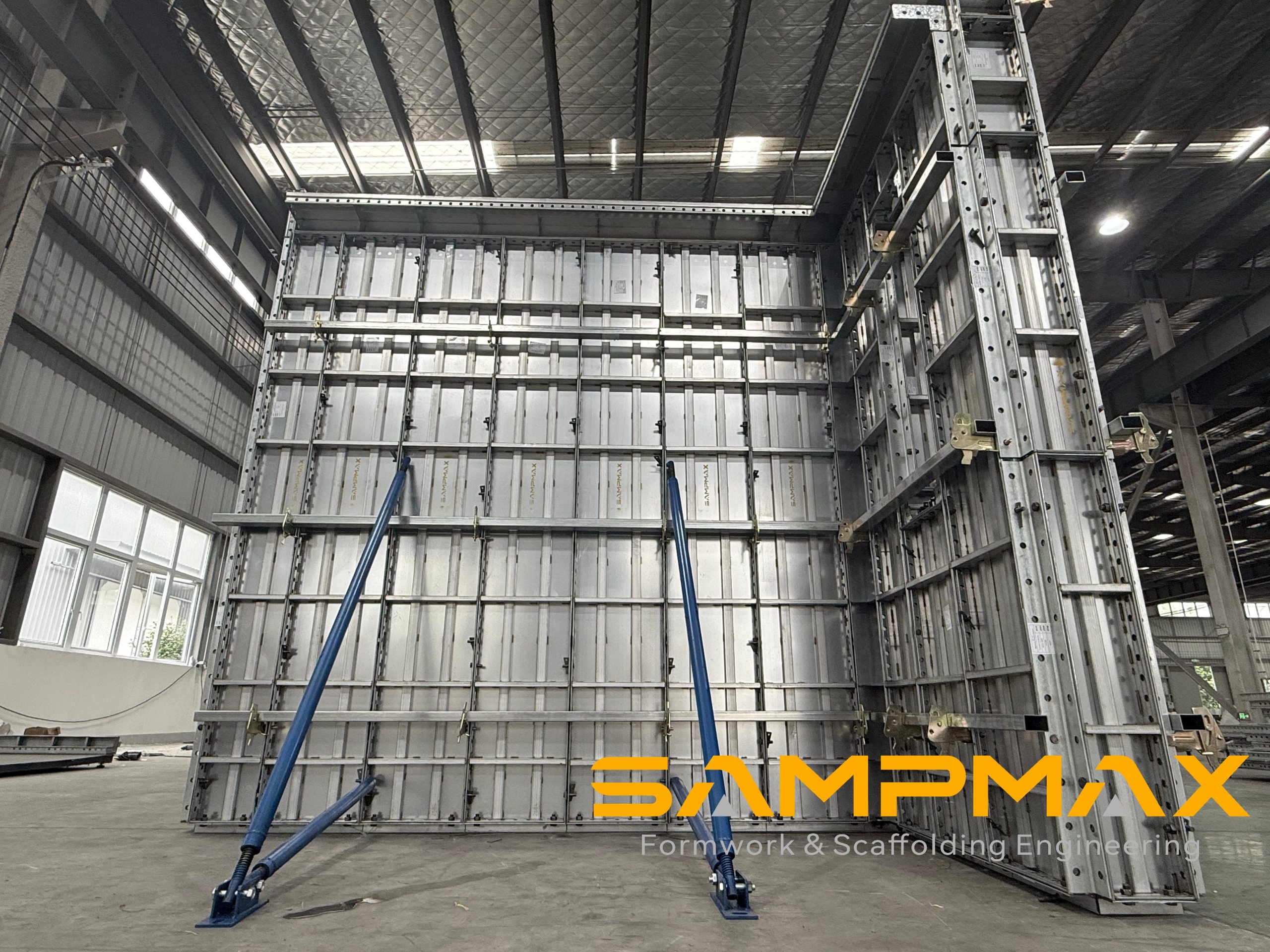

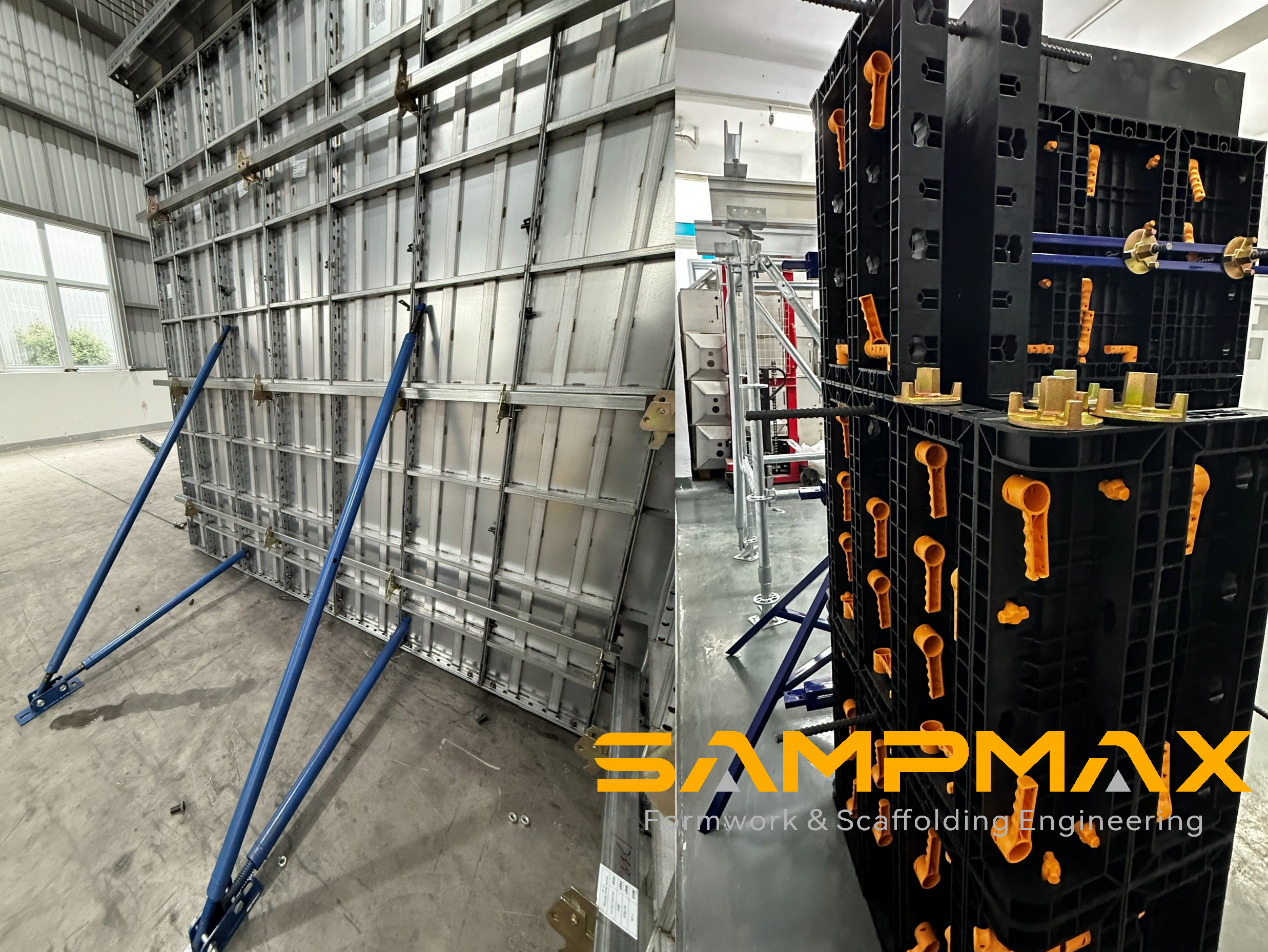
When specifying formwork for concrete structures, your choice of panel material directly affects three critical project outcomes: total cost over the project lifecycle, concrete surface quality, and on-site safety compliance.
Aluminum composite formwork and PVC plastic formwork have both gained traction as alternatives to traditional timber and all-steel systems — particularly for mid-scale projects. But their performance profiles diverge sharply depending on project scale, reuse frequency, and regulatory environment.
This guide breaks down both materials across four decision dimensions — cost, construction performance, durability, and fire safety — to help procurement teams make a well-informed call.
1. Material Structure: Know What You Are Actually Buying
Aluminum Composite Formwork (ACP Formwork)
Aluminum composite formwork is not solid aluminum. It uses a sandwich construction: two aluminum alloy face sheets bonded to a polyethylene (PE) or fire-retardant core, compressed under heat and pressure. This hybrid structure achieves the rigidity of metal while keeping weight manageable. Typical panel thickness is 15–20 mm, with a surface density of 8–12 kg/sqm.
The face surface is treated with a release coating, allowing clean concrete demolding. In most cases, the resulting concrete finish is smooth enough to meet fair-face concrete standards — eliminating the need for additional plastering.
PVC Plastic Formwork
PVC formwork is manufactured from rigid polyvinyl chloride by extrusion, available in solid sheet and hollow-core (lattice) profiles. At 4–7 kg/sqm, it weighs roughly half that of aluminum composite panels. PVC is inherently alkali-resistant, making it naturally compatible with the high-pH environment of fresh concrete. Its biggest on-site advantage is ease of processing: standard woodworking saws cut it cleanly, and panels can be heat-formed for curved geometry.
2. Cost Analysis: Low Unit Price Is Not the Same as Low Cost
Purchase price
- Aluminum composite formwork: $26–40 per sqm (market reference)
- PVC formwork: $9–17 per sqm — roughly one-third of aluminum composite
But reuse cycles are the variable that determines true lifecycle cost:
- Aluminum composite: 200–300 reuse cycles, ~$0.11–0.17 per sqm per pour
- PVC: 30–50 reuse cycles, ~$0.22–0.43 per sqm per pour
Procurement rule of thumb: If your project requires fewer than 30 pours, PVC offers a clear cost advantage. Beyond 50 pours — especially when the same formwork set is rotated across multiple projects — aluminum composite consistently delivers lower lifecycle cost per sqm.
3. Construction Performance: What Affects Schedule and Quality
Weight and handling
At 4–7 kg/sqm, PVC panels significantly reduce labor effort for installation, stripping, and vertical transport — an advantage on high-rise work where crane time and manual handling costs add up. Aluminum composite at 8–12 kg/sqm is heavier, though still far lighter than conventional steel formwork at 25–35 kg/sqm.
Concrete surface finish
Aluminum composite panels deliver consistently flat, tight-jointed surfaces. The metal frame maintains dimensional stability across temperature swings, keeping panel gaps minimal and producing concrete finishes that frequently meet fair-face specification without additional work.
PVC has a thermal expansion coefficient approximately five times higher than aluminum. In summer conditions, long PVC panels can develop slight bowing, increasing the risk of grout leakage at joints and resulting in visible surface ridges on the concrete. For projects where surface quality is a priority, this is a meaningful trade-off.
Adaptability to complex geometry
PVC’s main construction advantage is on-site flexibility. Panels can be cut with a standard saw and heat-formed into curves — useful for arched walls, circular columns, and other non-standard shapes. Aluminum composite requires dedicated cutting equipment and does not bend readily, limiting its practicality for heavily curved geometry.
4. Durability and Maintenance: The Hidden Long-Term Costs
When aluminum composite formwork is damaged, panels can typically be repaired by welding or resurfacing the face layer, extending service life and preserving the asset value. At end of life, the aluminum content can be sold as scrap — recovery values of $800–1,200 per tonne are common, partially offsetting the original purchase cost.
PVC panels, once cracked or deformed, are difficult to repair effectively. In most cases damaged sections require full panel replacement. At end of service, PVC has negligible scrap value, and disposal may carry an additional cost depending on local regulations.
In sustained high-temperature environments, PVC begins to soften above 60°C. Panels stored or used under direct summer sun in hot climates should be monitored for deformation. Aluminum composite formwork remains dimensionally stable well above this threshold.
5. Side-by-Side Comparison
| Criteria | Aluminum Composite Formwork | PVC Plastic Formwork | Winner |
| Purchase price | $26–40 /sqm | $9–17 /sqm | PVC (upfront) |
| Reuse cycles | 200–300 cycles | 30–50 cycles | Aluminum |
| Cost per use | ~$0.11–0.17/sqm | ~$0.22–0.43/sqm | Aluminum |
| Weight | 8–12 kg/sqm | 4–7 kg/sqm | PVC |
| Concrete surface finish | Excellent — fair-face ready | Good, slightly inferior | Aluminum |
| Panel joint accuracy | High (metal frame) | Lower (thermal expansion) | Aluminum |
| Heat deformation resistance | Stable up to 80°C | Softens above 60°C | Aluminum |
| Fire rating | Class B (flame-retardant core) | Emits toxic gases when burned | Aluminum |
| Repairability | Weldable / resurfaceable | Damaged panels need replacing | Aluminum |
| On-site cutting | Requires special tools | Standard woodworking saw | PVC |
| Curved / custom shapes | Limited bending | Heat-formable | PVC |
| Residual / scrap value | Aluminum scrap recoverable | Negligible | Aluminum |
6. Selection Guidance
Choose aluminum composite formwork when:
- Project scale is large (formwork area exceeding 500 sqm) with high reuse frequency
- Concrete surface quality is a specification requirement — fair-face or exposed finishes
- The project scope includes metros, tunnels, hospitals, schools, or other fire-regulated structures
- The same formwork set will be rotated across multiple projects to maximize lifecycle ROI
- Summer construction in high-temperature climates requires dimensional stability
Choose PVC formwork when:
- The project is small-scale with fewer than 30 anticipated pour cycles
- Upfront capital budget is constrained and initial procurement cost must be minimized
- The structure includes substantial curved or custom-shaped geometry requiring on-site forming
- Site equipment is basic and ease of cutting and handling is a priority
- No mandatory fire performance rating applies to the formwork specification