


Keywords: plastic formwork, construction formwork, ABS formwork, PP formwork, concrete formwork, formwork systems, reusable formwork
1. Why Plastic Formwork Has Become a Mainstream Option
Over the past decade, plastic formwork has moved from a niche alternative to a standard specification on a wide range of construction projects — from residential high-rises to municipal infrastructure and bridge works. Several converging factors explain the shift.
◎ Regulatory environment. Green building standards and government procurement guidelines in many markets increasingly favor reusable, recyclable materials for temporary works. For contractors bidding on public projects, formwork material selection has become part of compliance, not just cost management.
◎ Total cost of ownership. While plastic formwork carries a higher unit price than some alternatives, its high reuse cycle count — typically 50 to 100+ cycles depending on material — distributes that cost across a much longer service life. On projects with repeating geometry and high pour volumes, the lifecycle economics are compelling.
◎ Concrete finish quality. The smooth, non-absorbent surface of plastic panels produces clean concrete faces that can reduce or eliminate downstream plastering and patching — a meaningful saving on projects with exposed concrete or tight finish tolerances.
◎ Site handling. Plastic panels are lighter than many traditional options, which reduces manual handling effort and can modestly improve installation and stripping cycle times.
2. Main Types of Plastic Formwork: Materials, Compositions, and Trade-offs
The plastic formwork market is not monolithic. Five main material types are in active use, each with a distinct performance profile. Understanding the differences is essential for making an informed procurement decision.
(1) PP (Polypropylene) Formwork
Composition: Polypropylene resin, typically reinforced with glass fiber or mineral filler.
PP is the most widely distributed plastic formwork type globally. It offers solid rigidity, good chemical resistance, and reliable stripping performance.
◎ Moderate unit cost; 50+ reuse cycles under normal conditions; clean concrete release
× Toughness decreases noticeably at low temperatures; product quality varies significantly across manufacturers
(2) PVC (Polyvinyl Chloride) Formwork
Composition: PVC resin, either foamed (lightweight core) or solid extruded.
PVC panels are among the lightest available, which makes them easy to transport and handle on site.
◎ Very low self-weight; easy to cut in the field; low upfront cost
× Lower structural stiffness — prone to deflection under high lateral concrete pressure; susceptibility to UV degradation with prolonged outdoor exposure
(3) WPC (Wood-Plastic Composite) Formwork
Composition: Bamboo or wood flour blended with thermoplastic resins (PE or PP), hot-press formed.
WPC panels bridge the handling characteristics of natural fiber materials and the durability benefits of thermoplastics.
◎ Good dimensional stability; accepts mechanical fasteners; compatible with conventional site workflows
× Higher self-weight than all-plastic options; water resistance is improved over natural materials but not equivalent to solid plastic panels
(4) FRP (Fiber-Reinforced Polymer) Formwork
Composition: Unsaturated polyester resin laminated with fiberglass fabric layers.
FRP occupies the high end of the structural performance spectrum — stiff, strong, and long-lasting.
◎ High load-bearing capacity; 80+ reuse cycles; premium concrete surface quality
× Highest unit price; requires specialized cutting tools; difficult to recycle at end of life
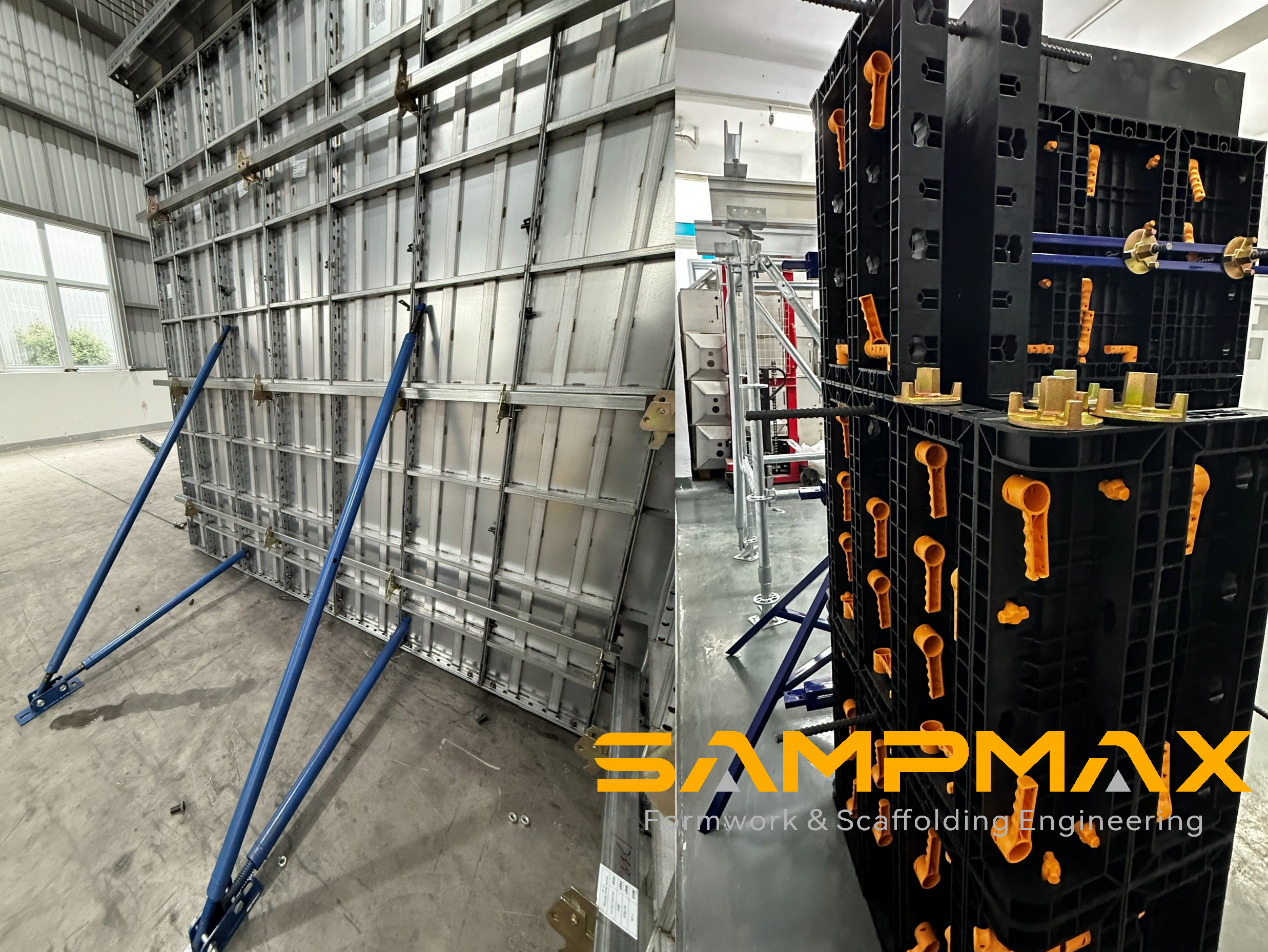
(5) ABS (Acrylonitrile Butadiene Styrene) Formwork
Composition: ABS terpolymer — a precision blend of acrylonitrile, butadiene, and styrene — typically produced by injection molding or sheet extrusion.
ABS is an engineering-grade thermoplastic with an established track record in industrial applications that require both mechanical toughness and dimensional consistency. These properties carry over directly into construction formwork performance.
◎ Impact resistance: The butadiene component gives ABS substantially better toughness than PP or PVC, including at low temperatures — reducing the risk of cracking or surface damage during stripping and stacking
◎ Dimensional accuracy: ABS maintains its geometry under load with minimal flex, which translates into consistent concrete dimensions across repeated pours
◎ Surface quality: The smooth mold surface produces high-grade concrete finishes and is well-suited to projects with exposed concrete or reduced-plastering specifications
◎ Reuse cycles: Quality ABS panels routinely achieve 50–80+ cycles under normal operating conditions
◎ Recyclability: ABS is a widely accepted recyclable thermoplastic, making end-of-life processing more practical than composite materials
× Higher unit price than PP or PVC
× Extended direct UV exposure without surface treatment can affect long-term surface quality — panels should be stored out of direct sunlight when not in use
For projects where surface finish standards, dimensional repeatability, or site conditions vary significantly, ABS offers a strong technical case. Its advantages become most visible when evaluated on total lifecycle cost rather than purchase price alone.
3. Typical Applications
Plastic formwork is well-suited to a wide range of structural applications, with performance advantages most pronounced in the following situations:
◎ Standard floor slabs, shear walls, and columns with repetitive geometry — the high reuse cycle count delivers maximum value where pour sequences repeat
◎ Wet and below-grade environments — the non-absorbent surface resists moisture, eliminating the swelling and warping that can affect other panel types in humid conditions
◎ Projects with concrete finish requirements — smooth plastic surfaces reduce the need for remedial plastering, particularly relevant for exposed concrete facades or interior surfaces
◎ Projects where stripping efficiency matters — clean release and light panel weight support faster cycle times in the formwork sequence
Plastic formwork is less suited to applications involving heavily irregular or curved geometry requiring extensive field cutting, or to very short-duration projects where the initial investment cannot be recovered across sufficient reuse cycles.
4. Limitations to Factor Into Your Decision
◎ Higher upfront cost. Plastic formwork requires more capital outlay per panel than some alternatives. The economics depend on achieving a sufficient number of reuse cycles — this should be estimated based on your specific project program before committing.
◎ Lower on-site adaptability. Plastic panels are less easily cut, nailed, or modified in the field compared to materials that can be worked with standard carpentry tools. This places greater importance on pre-pour planning and standardized design dimensions.
◎ Inconsistent market quality. The plastic formwork market includes products with significantly varying performance. Advertised reuse cycle counts and load ratings are not always independently verified. When evaluating suppliers, request third-party test reports and ask for documented project references.
◎ End-of-life handling. Thermoplastics such as ABS and PP are technically recyclable, but collection and reprocessing infrastructure varies by region. It is worth clarifying the supplier’s take-back or recycling arrangements before finalizing a large procurement.
Summary
Plastic formwork has earned its place as a reliable, efficient option across a broad range of construction project types. The five material categories on the market today serve different performance requirements and budget profiles — there is no single correct answer, but there is usually a best fit for a given project.
If you are assessing formwork options for an upcoming project and would like technical input on material selection, panel sizing, or quantity planning, our team is available to help.
Learn more about Sampmax PLATOX plastic formwork: https://www.sampmax.com/solutions/sampmax-sp600-formwork/