

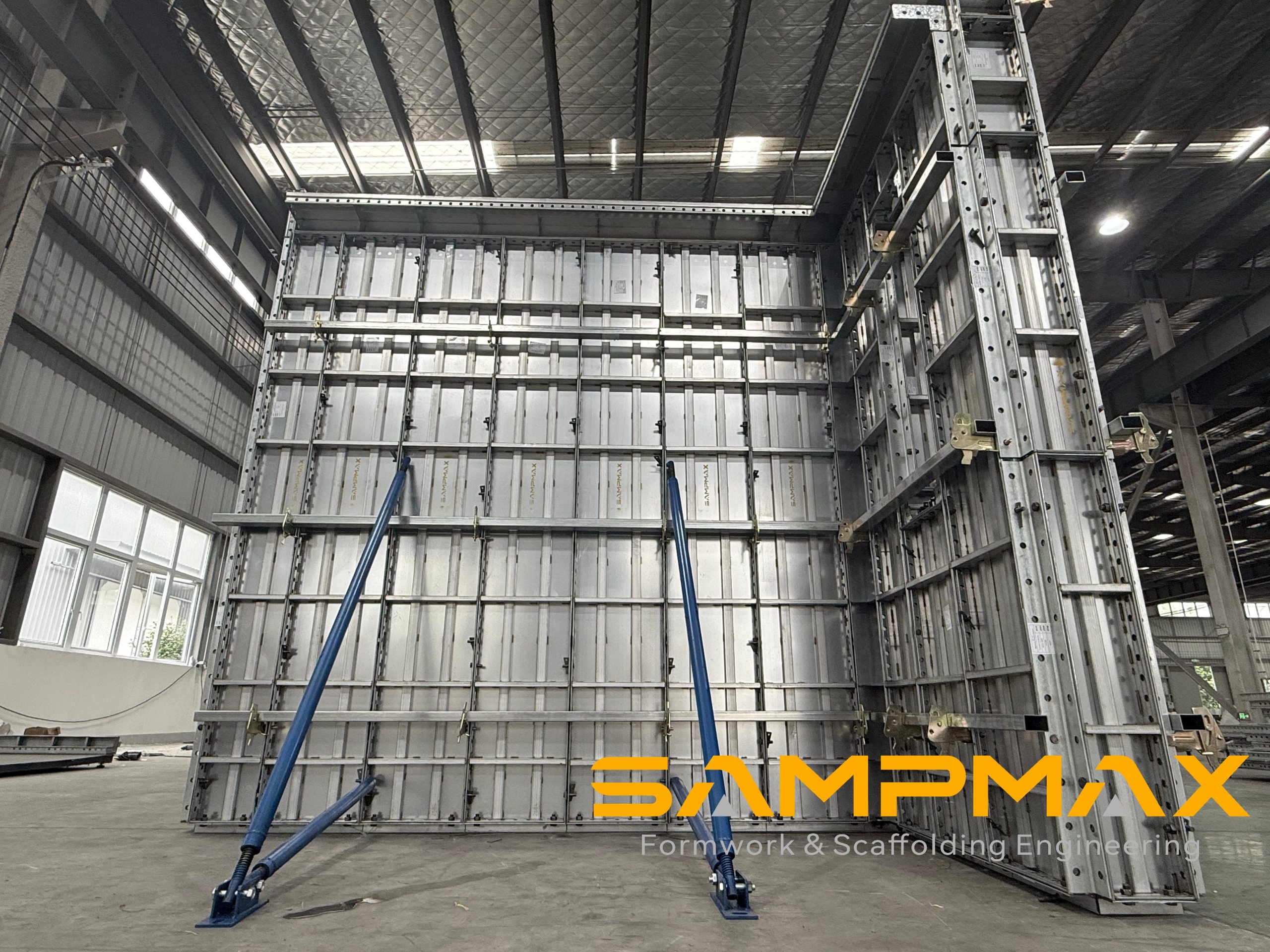

Plastic formwork is lightweight and reusable — but single-pour casting can warp, bow, and crack it. Learn the three physics reasons why layered pouring matters.
Plastic formwork has become increasingly popular on modern construction sites — it is lightweight, corrosion-resistant, and reusable. Yet experienced engineers consistently warn against using it for monolithic (single-pour) concrete casting, especially for walls, columns, and large structural elements. Why? The answer comes down to three fundamental physics problems that no amount of bracing can fully overcome.
What Is Single-Pour Casting?
Single-pour casting — also called monolithic or one-shot casting — means placing the full volume of concrete into a formwork system in one continuous operation, without stopping for each layer to partially set. It is attractive because it saves time and reduces cold joints. However, it places enormous and sustained mechanical and thermal demands on the formwork itself.
Problem 1: Lateral Pressure Increases Dramatically With Depth
Fresh concrete behaves like a fluid before it begins to set. Just like water in a tank, it exerts hydrostatic lateral pressure on the surrounding formwork. The deeper the concrete, the greater the pressure at that point. For a wall poured to a height of 3 meters, the lateral pressure at the base can easily exceed 40–60 kN/m².
Plastic formwork panels have an elastic modulus of roughly 2–3 GPa — approximately 1/70th that of steel and 1/10th that of timber. Under sustained lateral pressure of this magnitude, plastic panels will:
〇 Bow outward, causing the finished concrete surface to bulge
〇 Deflect beyond allowable tolerances, resulting in structural elements that fail dimensional inspection
〇 Shift at joints, breaking the seal between panels
Steel and timber formwork resist this pressure through high rigidity. Plastic simply does not have the stiffness to maintain its shape under a full single-pour load.
Problem 2: Hydration Heat Causes Thermal Deformation
When cement reacts with water, it releases significant heat through a process called hydration. In a standard concrete mix, internal temperatures can rise to 50–70°C within the first 12–24 hours of casting. In mass concrete pours, this figure can climb even higher.
This heat creates a serious mismatch between plastic and concrete:
| Material |
Thermal Expansion Coefficient |
| Plastic (PVC / PP) |
70–150 × 10⁻⁶ /°C〇 |
| Concrete |
10–12 × 10⁻⁶ /°C |
| Steel |
11–13 × 10⁻⁶ /°C |
Plastic expands 5 to 9 times more than concrete for the same temperature increase. During a single large pour, this means:
〇 Plastic panels warp and soften as internal temperature rises
〇 Joints open up under the combined thermal expansion and concrete pressure
〇 Cement slurry leaks out through the gaps, creating surface defects
〇 On cooling, the plastic contracts unevenly, leaving permanent dimensional errors in the finished element
Layered pouring allows heat to dissipate between lifts, keeping temperatures — and thermal stresses on the formwork — manageable at each stage.
Problem 3: Joints Cannot Withstand Full-Column Pressure
Plastic formwork panels are joined by mechanical clips, pins, or interlocking edges. These connections are designed for moderate, distributed loads — not the sustained, high-pressure conditions of a full-height single pour.
When the full weight of uncured concrete acts simultaneously on every joint in the system:
〇 Joint gaps open, allowing bleed water and cement paste to escape
〇 Panel alignment shifts, producing ridges, fins, and mismatched surfaces on the finished concrete
〇 Surface defects accumulate, including honeycombing (voids where aggregate is exposed), blow-holes, and cold-pour lines
These are not merely cosmetic issues. Honeycombing in a structural wall or column reduces effective cross-sectional area and can compromise load-bearing capacity, requiring costly repair or demolition.
The Right Approach: Layered Pouring
The solution is straightforward: pour in lifts of 300–500 mm, allowing each layer to begin initial setting (typically 1–2 hours in normal conditions) before the next lift is placed. This approach:
〇 Keeps lateral pressure within the rated capacity of plastic panels
〇 Limits heat buildup to manageable levels at each stage
〇 Maintains joint integrity throughout the pour
〇 Reduces the risk of surface defects and dimensional non-compliance
Vibration should be applied to each lift to ensure proper consolidation, and the vibrator should penetrate slightly into the layer below to create good bond between lifts.
When Can Plastic Formwork Handle Higher Pours?
Plastic formwork can be used for taller elements when combined with:
〇 Heavy-duty steel walers and tie rods that transfer lateral load away from the plastic panels
〇 Reduced pour rates (measured in meters of rise per hour) rather than unrestricted single pours
〇 Temperature-controlled concrete mixes with lower heat of hydration (e.g., using blended cement with fly ash or slag)
In these configurations, the plastic acts as a facing and mold surface while the steel structure carries the structural load — combining the weight and corrosion advantages of plastic with the rigidity of steel.
Summary
| Factor | Why It Matters for Plastic Formwork |
| Low elastic modulus | Panels bow under deep pour pressure |
| High thermal expansion | Hydration heat warps and opens joints |
| Mechanical joint limits | Full-column pressure exceeds joint capacity |
| Solution | Layered pouring at 300–500 mm per lift |
Plastic formwork is an excellent construction material when used correctly. It is the single-pour method — not the material itself — that creates the problem. Understanding the underlying physics of lateral pressure, hydration heat, and joint mechanics helps engineers and site managers make informed decisions that protect both the structure and the investment in formwork.
Learn More aboutSampmax PLATOX plastic formwork: