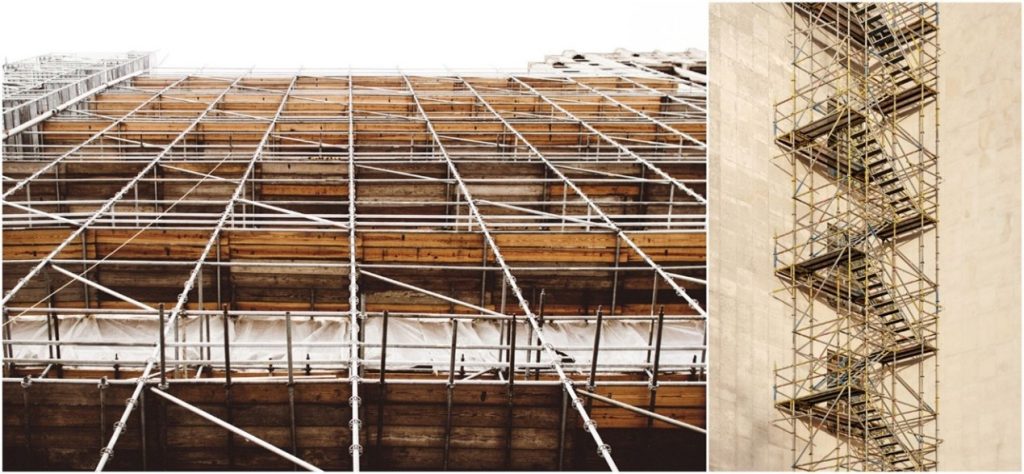
Firstly, find out the factors that affect the safety of ringlock scaffolding. There are three main aspects: one is the safety and reliability of ringlock scaffolding itself, the second is the safety protection measures of ringlock scaffolding, and the third is the safe operation of ringlock scaffolding. Let’s take a look separately.
Ruggedness and stability are the safe and reliable foundation of ringlock scaffolding. Under allowable load and weather conditions, the structure of ringlock scaffold must be stable without shaking, shaking, tilting, sinking, or collapsing.
To ensure the safety and reliability of ringlock scaffolding, the following basic requirements should be ensured:
1) The frame structure is stable.
The frame unit shall be of a stable structure; the frame body shall be provided with diagonal rods, shear braces, wall rods, or bracing and pulling parts as required. In the passages, openings, and other parts that need to increase the structural size (height, span) or bear the specified load, strengthen the rods or braces according to the needs.
2) The connection node is reliable.
The cross position of the rods must meet the requirements of the node structure; the installation and fastening of the connectors meet the requirements. The connecting wall points, support points and suspension (hanging) points of the disc-buckle scaffolding must be set at the structural parts that can reliably bear the support and tension load, and the structure check calculation should be carried out if necessary.
3) The foundation of the disc scaffold should be firm and firm.
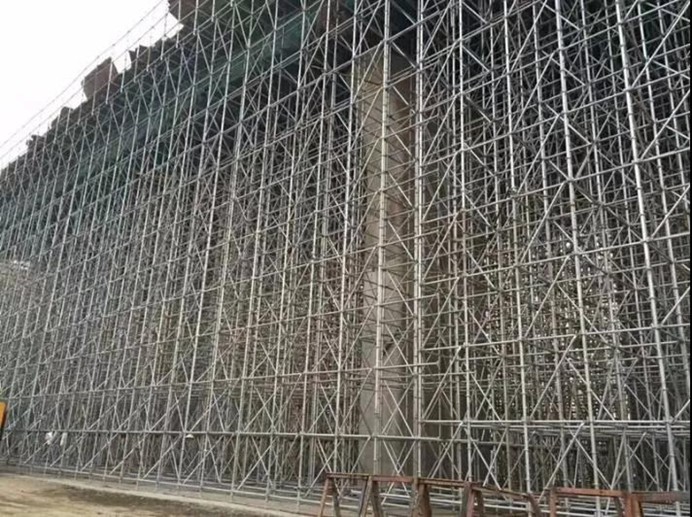
Safety protection of disc scaffolding
The safety protection on the ringlock scaffold is to use safety facilities to provide safety protection to prevent people and objects on the rack from falling. Specific measures include:
1) Ringlock scaffolding
(1) Safety fences and warning signs should be set up on the job site to prohibit irrelevant personnel from entering the dangerous area.
(2) Temporary supports or knots should be added to the ringlock scaffolding parts that have not been formed or have lost structural stability.
(3) When using a seat belt, a safety rope should be pulled when there is no reliable seat belt buckle.
(4) When dismantling the ringlock scaffolding, it is necessary to set uplifting or lowering facilities, and throwing is prohibited.
(5) Movable ringlock scaffolds such as hoisting, hanging, picking, etc., should be supported and pulled to fix or reduce their shaking after moving to the working position.
2) Operating platform (work surface)
(1) Except that 2 scaffolding boards are allowed to be used for decoration ringlock scaffolding with a height of less than 2m, the working surface of other ringlock scaffolding shall not be less than 3 scaffold boards, and there is no gap between the scaffold boards. The gap between the faces is generally not more than 200mm.
(2) When the scaffold board is flat-joined in the length direction, its connecting ends must be tightened, and the small crossbar under its end should be fixed firmly and not floating to avoid sliding. The distance between the center of the small crossbar and the board ends should be Control in the range of 150-200mm. The scaffold boards at the beginning and end of the ring lock scaffold should be reliably bolted to the ringlock scaffold; when lap joints are used, the lap length must not be less than 300mm, and the beginning and end of the scaffold must be fastened firmly.
(3) The protective facilities facing the outer facade of the operation can use scaffolding boards plus two protective railings, three railings plus outer plastic woven cloth (height not less than 1.0m or set according to steps). Two levers are used to tie a bamboo fence with a height of not less than 1m, two railings are fully hung with safety nets or other reliable enclosure methods.
(4) The frontage and pedestrian transportation channels:
① Use plastic woven cloth, bamboo fence, mat, or tarpaulin to completely close the street surface of the ringlock scaffolding.
②Hang safety nets on the frontage, and set up safety passages. The top cover of the passage should be covered with scaffolding or other materials that can reliably bear falling objects. The side of the canopy facing the street should be provided with a baffle no less than 0.8m higher than the canopy to prevent falling objects from rebounding onto the street.
③ Pedestrian and transportation passages that are close to or passing through the ringlock scaffolding must be provided with tents.
④The entrance of the upper and lower ringlock scaffolding with a height difference should be provided with ramps or steps and guardrails.
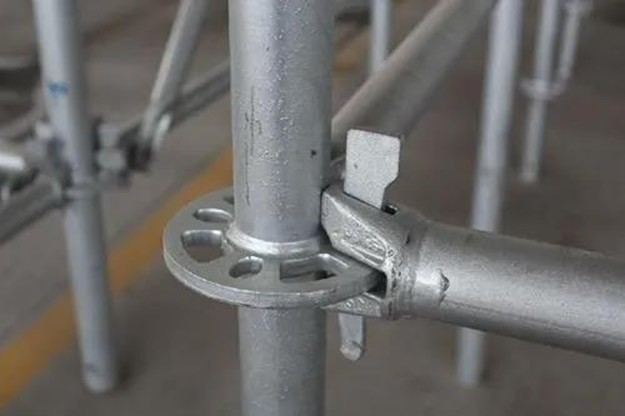
The safe operation of using ringlock scaffolding
1) The use load must meet the following requirements
(1) The load on the working surface (including scaffolding boards, personnel, tools and materials, etc.), when the design is not specified, the masonry work frame load shall not exceed 3kN/㎡, and the other main structural engineering workload shall not exceed 2kN/㎡, The load of decoration work shall not exceed 2kN/㎡, and the load of protection work shall not exceed 1kN/㎡.
(2) The load on the work surface should be evenly distributed to avoid excessive loads being concentrated together.
(3) The number of scaffolding layers and simultaneous working layers of ringlock scaffolding shall not exceed the regulations.
(4) The number of paving layers and load control of the transfer platform between the vertical transportation facilities (Tic Tac Toe, etc.) and the ringlock scaffold shall not exceed the requirements of the construction organization design, and the number of paving layers and excessive stacking of construction materials shall not be arbitrarily increased.
(5) Lining beams, fasteners, etc. should be installed along with the transport, and shall not be stored on the ringlock scaffolding.
(6) Heavier construction equipment (such as electric welders, etc.) shall not be placed on the ringlock scaffolding.
2) The basic components and connecting wall parts of the scaffold shall not be dismantled arbitrarily, and various safety protection facilities of the scaffold shall not be dismantled arbitrarily.
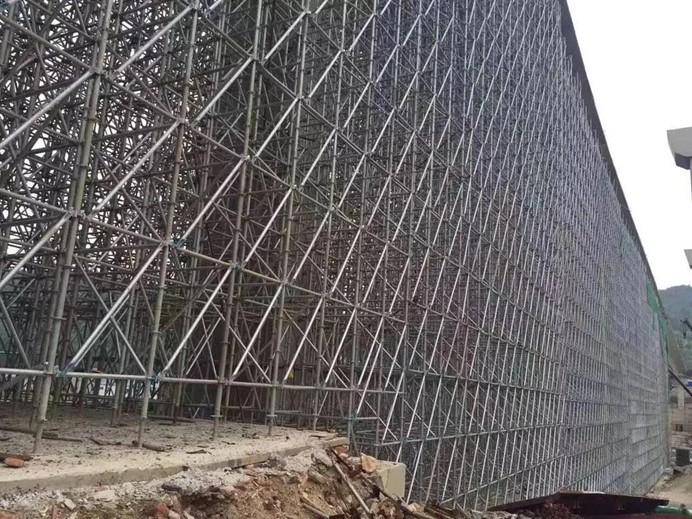
3) Basic rules for the correct use of disc scaffolding
(1) The materials on the working surface should be cleaned up in time to keep the working surface tidy and unobstructed. Do not place tools and materials randomly, so as not to affect the work safety and cause falling objects and hurt people.
(2) At the end of each work, the materials on the shelf have been used up, and the unused ones should be stacked neatly.
(3) When performing operations such as prying, pulling, pushing, and pushing on the working surface, take the correct posture, stand firm or hold a firm support, so as not to lose stability or throw things out when the force is too strong.
(4) When electric welding is performed on the working surface, reliable fire prevention measures should be taken.
(5) When working on the rack after rain or snow, the snow and water on the working surface should be removed to prevent slipping.
(6) When the height of the working surface is not enough and needs to be raised, a reliable method of raising shall be adopted, and the height of raising shall not exceed 0.5m; when it exceeds 0.5m, the paving layer of the shelf shall be raised according to the erection regulations.
(7) Vibrating operations (rebar processing, wood sawing, placing vibrators, throwing heavy objects, etc.) are not allowed on the disc-buckle scaffolding.
(8) Without permission, it is not allowed to pull wires and cables on the buckle scaffolding, and it is not allowed to use open flames on the buckle scaffold.



.jpg)
-855x1024.jpg)
-904x1024.jpg)
.jpg)
.jpg)
.jpg)
.jpg)
.png)